
FIFA World Cup 2026 Betting
Decimal Odds Explained NZ - How to Read Betting Odds
 Available in US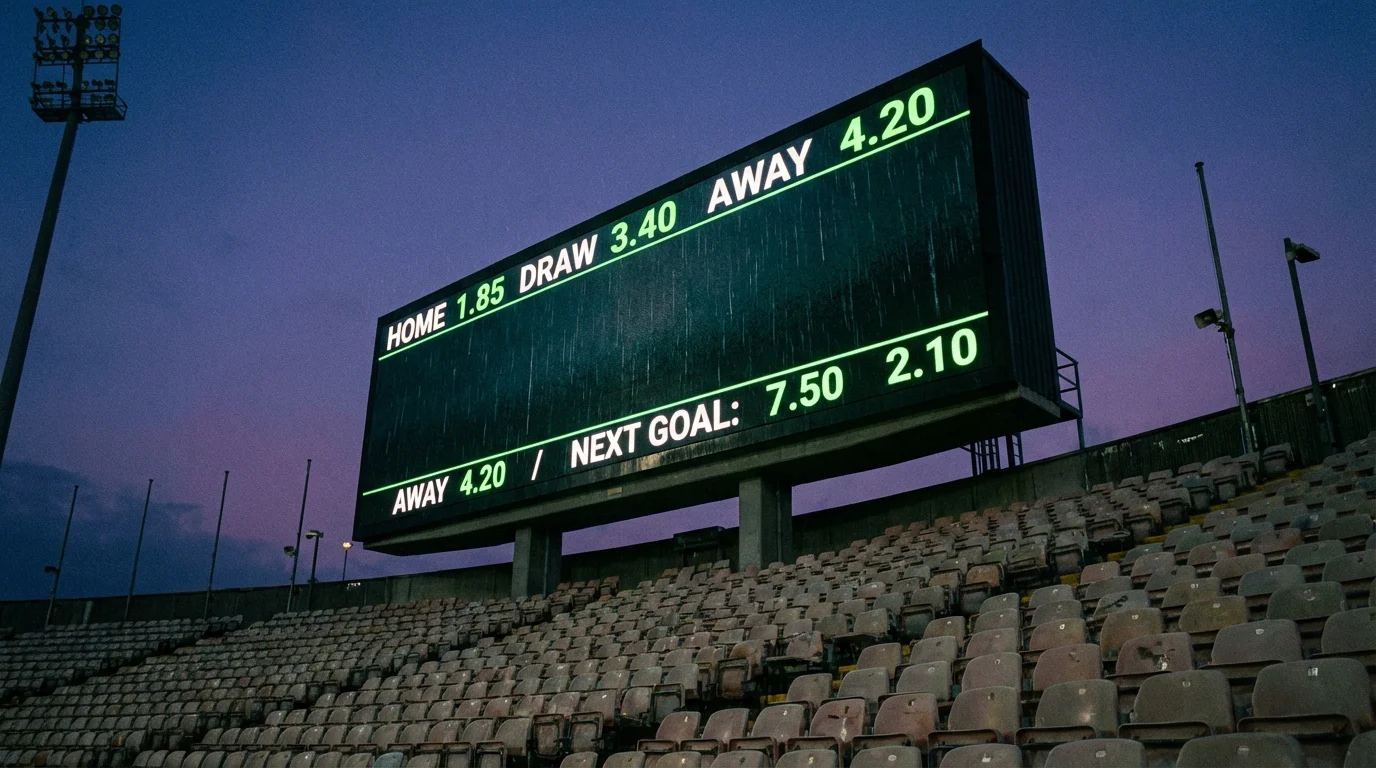
If you have ever looked at a TAB NZ screen and seen a number like 3.40 next to a team’s name without quite knowing what it meant beyond “something to do with how much I win,” you are not alone. Decimal odds are the standard format in New Zealand – every price on TAB NZ, every number on a pub screen during the World Cup – yet a surprising number of Kiwi punters operate on instinct rather than understanding. They know that bigger numbers mean longer shots and smaller numbers mean favourites. That is correct, but it is like knowing that a car goes faster when you push the accelerator without understanding what the speedometer actually reads.
Decimal odds are the simplest odds format in the world. That is not an opinion; it is structural fact. They tell you exactly how much you receive back for every dollar staked, and they make calculating your total return a matter of one multiplication. No fractions, no plus-minus signs, no mental gymnastics. New Zealand, Australia, and most of continental Europe use decimal odds as the default, and once you understand the format, you will wonder why anyone uses anything else.
How Decimal Odds Work
I explain this to new punters the same way every time, and it takes about 30 seconds. The decimal number is your total return per dollar staked. Not your profit – your total return, including your original stake. If the All Whites are priced at 4.50 to beat Egypt and you place $20, your total return is $20 x 4.50 = $90. Your profit is $90 minus your $20 stake = $70. That is the entire system.
The key distinction is between return and profit. Decimal odds of 2.00 mean you double your money – $10 becomes $20, which is $10 profit. Odds of 1.50 mean your $10 becomes $15 – a $5 profit. Odds of 1.10 mean your $10 becomes $11 – a modest $1 profit on what the market considers a near-certainty. Every decimal odd below 2.00 returns less than your stake as profit. Every odd above 2.00 returns more than your stake as profit. The number 2.00 is the breakeven line – the point where profit equals stake.
Why does the return include the original stake? Because that is how the payout works mechanically. When your bet wins, TAB NZ pays you the total return – stake plus profit in one lump sum. Fractional odds (used in the UK and Ireland) show only the profit portion: 3/1 means you win $3 for every $1 staked, which is equivalent to decimal 4.00 (3 profit + 1 stake). The decimal format rolls everything into a single number, which makes multi-bet calculations dramatically simpler.
For any World Cup match on TAB NZ, you will see three decimal odds on the head-to-head market: one for each possible outcome. Belgium 1.35, Draw 4.80, New Zealand 9.00. The lowest number (1.35) indicates the most likely outcome according to the bookmaker. The highest number (9.00) indicates the least likely. The middle number (4.80) sits between the two. Reading a TAB NZ market display is, at its core, reading a probability ranking disguised as payout multipliers.
Calculating Your Returns in NZD
There is a mental shortcut I have used for years that makes on-the-spot calculations instant: subtract 1 from the decimal odds to get the profit multiplier, then multiply by your stake. At odds of 3.40, your profit per dollar is 2.40. A $25 bet profits $60. Total return: $85. Done in your head, no calculator needed.
For multi-bets, the calculation chains. Multiply the decimal odds of each leg together to get the combined odds, then multiply by your stake. Three legs at 1.80, 2.20, and 1.50 produce combined odds of 1.80 x 2.20 x 1.50 = 5.94. A $10 multi returns $59.40 if all three legs win. Your profit is $49.40. The beauty of decimal odds in multis is that this calculation works identically regardless of how many legs you add – just keep multiplying.
TAB NZ displays your potential return on the bet slip before you confirm, so you never need to calculate manually unless you want to. But knowing the maths matters for two reasons. First, it lets you assess value before you even look at the bet slip – if you know that 2.50 odds on an outcome implies your $20 returns $50, you can instantly decide whether $30 profit justifies the risk. Second, it protects you from errors. If TAB NZ’s displayed return does not match your mental calculation, something is wrong – either you have misread the odds or there is a system error, and in either case you want to catch it before confirming.
All returns on TAB NZ are paid in NZD. There is no currency conversion, no exchange rate to factor in, and – this is the part that makes Kiwi punters smile – no tax on winnings. New Zealand does not tax gambling profits for recreational bettors. Your $90 return on a $20 bet is $90 in your TAB NZ account, not $90 minus a government cut. That structural advantage makes New Zealand one of the most punter-friendly jurisdictions in the world, even with the TAB NZ monopoly limiting operator choice.
Decimal vs Fractional vs American – A Quick Comparison
During the World Cup, you will encounter odds in all three major formats: decimal (New Zealand, Australia, Europe), fractional (United Kingdom, Ireland), and American (United States). Since the 2026 tournament is hosted in North America and broadcast globally, media coverage will mix formats freely. Knowing how to translate between them prevents confusion when you see a pundit on Sky Sport quoting 5/2 and you are thinking in decimal.
Fractional odds show profit relative to stake. 5/2 means $5 profit for every $2 staked. To convert to decimal: divide the fraction (5 / 2 = 2.50) and add 1. Decimal equivalent: 3.50. Going the other direction, subtract 1 from the decimal odds and express as a fraction: 3.50 becomes 2.50, which is 5/2. Straightforward fractions like 2/1 (decimal 3.00) or 1/1 (decimal 2.00, also called “evens”) convert easily, but awkward fractions like 11/8 (decimal 2.375) illustrate why decimal is the cleaner format.
American odds use positive and negative numbers. Positive odds (+250) tell you the profit on a $100 stake: +250 means $250 profit. To convert to decimal: divide by 100 and add 1. +250 = 3.50. Negative odds (-150) tell you the stake needed to profit $100: -150 means you must risk $150 to win $100. To convert: divide 100 by the absolute value (100 / 150 = 0.667) and add 1. -150 = 1.667. American odds are confusing, and the only reason to know them is that US-based World Cup coverage will use them extensively.
The practical takeaway for Kiwi punters: ignore fractional and American formats in your own analysis. Use decimal throughout. If you see a pundit or social media tipster quoting odds in another format, convert to decimal before assessing the value. TAB NZ operates exclusively in decimal, and your betting decisions should be made in the same language as your bankroll.
What Odds Tell You About Probability
Every decimal odd contains an implied probability, and extracting it is the single most useful skill a punter can develop. The formula: divide 1 by the decimal odds, multiply by 100. Odds of 2.50 imply a 40% probability (1 / 2.50 = 0.40). Odds of 5.00 imply 20%. Odds of 1.25 imply 80%. This conversion turns a payout multiplier into a probability statement, and that statement is what you should be evaluating – not the payout itself.
Why does this matter? Because two bets can offer the same dollar return but carry wildly different value. A $20 bet at 5.00 returns $100 – and implies the outcome has a 20% chance. A $50 bet at 2.00 also returns $100 – but implies a 50% chance. If you believe the first outcome actually has a 30% chance and the second actually has a 45% chance, the first bet is value (your estimate exceeds the market’s) and the second is not (your estimate is below the market’s). The dollar return is identical; the expected value is not.
The catch is the bookmaker’s margin. If you sum the implied probabilities of all outcomes in a market, the total exceeds 100%. In a typical World Cup head-to-head market – Belgium 1.35 (74.1%), Draw 4.80 (20.8%), New Zealand 9.00 (11.1%) – the sum is 106.0%. That extra 6.0% is the overround, the bookmaker’s built-in edge. To find the “true” implied probability (stripped of margin), divide each implied probability by the total: Belgium’s true implied probability is 74.1 / 106.0 = 69.9%. This adjusted number is what you compare against your own estimate.
For the 2026 World Cup, I track implied probabilities across all 72 group-stage fixtures in a spreadsheet, compare them against my model’s probabilities, and flag every outcome where my number exceeds the market’s by 5 percentage points or more. That process begins with decimal odds explained in exactly the way I have outlined here – converting the raw numbers into probabilities and then comparing them against my analysis. The odds are not just prices; they are the market’s opinion, and opinions can be wrong.
Reading Odds on TAB NZ
TAB NZ’s interface displays decimal odds on every market, and the layout is consistent whether you are using the app, the desktop site, or the physical TAB screen at your local pub. For a World Cup head-to-head market, you will see the two team names flanking a central “draw” column, with the decimal price under each option. Tapping a price adds it to your bet slip, where TAB NZ calculates the potential return based on your stake.
Odds on TAB NZ move in response to betting volume and market information. If heavy money comes in on Belgium to beat the All Whites, Belgium’s price shortens (say, from 1.35 to 1.28) while New Zealand’s price drifts (from 9.00 to 10.00). These movements reflect changing market sentiment, not changing probability – Belgium are not suddenly more likely to win because punters bet on them. But the movement does affect value: if New Zealand at 9.00 was borderline value, New Zealand at 10.00 (implying 10% instead of 11.1%) might cross the threshold.
One TAB NZ-specific feature worth understanding is the “fixed odds” label. When you place a bet at decimal odds of 4.50, those odds are locked. It does not matter if the price moves to 5.20 or drops to 3.80 after your bet is confirmed – your payout is calculated at 4.50. This differs from tote (pool) betting, where the final dividend depends on the total pool size and is not known until after the event. For World Cup betting, fixed odds are the standard, and the certainty they provide is one reason serious punters prefer fixed-odds markets over tote pools.
Decimal odds explained in this way should give every Kiwi punter the confidence to read any TAB NZ market, calculate returns instantly, and – most importantly – convert those odds into probabilities that drive smarter decisions. The 2026 World Cup offers 104 matches, each with multiple markets and hundreds of individual prices. Every single one of those prices is a decimal odd waiting to be understood.
